Categories
Uncategorized

FEIN sets new construction sector safety standards

With 52,800 responsible and committed employees in more than 60 countries, Bouygues Construction designs, builds and operates projects across the building, civil works, energy and services sectors. One of the world’s largest construction firms and a leader in sustainable construction, the group sees shared innovation as its primary added value and ensures that health and safety are its top priorities, adopting a ‘zero accidents’ policy.

Challenge

Following a serious accident on one of its sites in France, Bouygues banned the use of compact angle grinders (115mm-150mm) in 2017. In line with this the firm set up a steering committee, which was tasked with defining the specification for hand held power tools to ensure all operators use the most efficient and appropriate tools, in compliance with Bouygues’ health and safety requirements.

Upon the appointment of the steering committee and the identification of the safety concerns around the use of compact angle grinders on site, the group invited tenders from manufacturers to develop a prototype that met its strict safety requirements. These included features such as compulsory two-handed operation, non-removable safeguard, an additional safeguard cover and anti-kickback function. Additionally, a non-removable side handle and electric brake function were required.

The committee selected FEIN’s proposal, which met the precise technical specifications and guaranteed a tool that met Bouygues Construction’s health and safety standards.

The dangers associated with angle grinders

According to RoSPA (The Royal Society for the Prevention of Accidents), angle grinders are classified amongst the most dangerous tools in industry, ranking third most dangerous, with 5,400 injuries recorded annually[i]. Further to this, HSE (Health and Safety Executive) revealed that in 2020-21 alone, the UK construction sector saw 39 fatal injuries[ii] and, in 2019, over a fifth (22%) of fatal accidents at work in the EU were as a result of losing control of a machine, tool or transport/handling equipment[iii].

The following sources of danger are amongst the most common when operating angle grinders/cut-off machines:

The wheel guard is not mounted, the grinding wheel breaks and the fragments injure the user
Working with one hand on the machine/the user holds machine with only one hand, which is the cause of around 40% of accidents
A kick-back of the grinding wheel blocks, causing the machine to suddenly jump away from the work piece, resulting in danger/risk of an accident

The consequences of these dangers include:

Serious injury to the operator
Liability to the employer
Loss of productivity
Long term effects/injury to the operator

FEIN’s solution

In May 2022 the much-anticipated cordless 18v Protago high-safety angle grinder, which will be available to the wider market from July 2022, was unveiled in the UK.
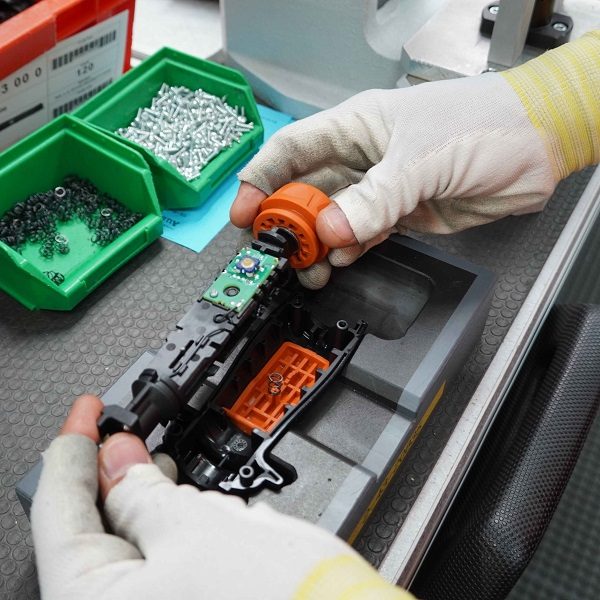
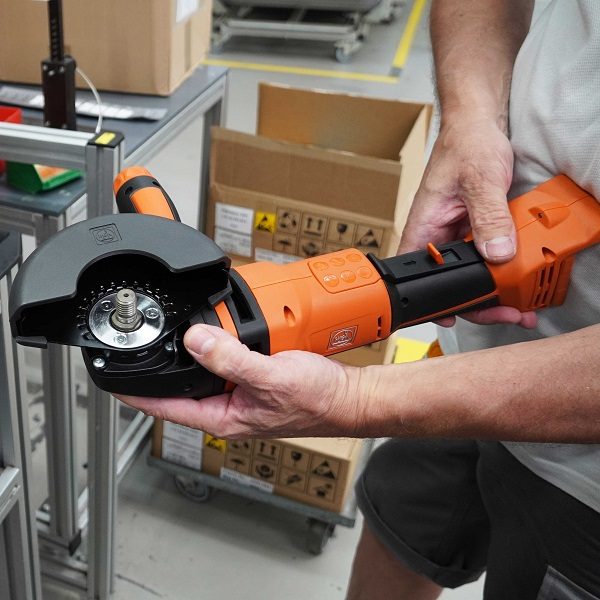
The Protago’s non-removeable wheel guard protects users from flying fragments, while users are unable to operate the high-safety angle grinder with one-hand due to an integrated ‘AutoStop’ dead man’s switch and permanently mounted non-removeable additional handle, which only enables two-hand operation. Upon one hand being removed, power to the tool will automatically disable; while its anti-kickback function detects any sudden movements, such as loss of control, automatically shutting off.

The Protago is already making an impression on the sector as the recipient of a prestigious Red Dot Design Award, winning “best of the best” in the tools category, as a result of its patented technology which is expected to considerably change how angle grinders are operated globally.

The tool exceeds strict occupational safety requirements and comes with several new market leading built-in features that have been developed with a primary focus on health and safety. As well as the non-removable wheel guard, this includes an additional six-position non-removable adjustable side handle that enables flexible working in compact spaces, and the newly-developed enhanced anti-kickback detection function.

To select the most suitable handle positions for the grinder and the user, FEIN used the Ironhand glove for testing purposes. This method was used to ensure the operator had ease of use when applying pressure to the dead man’s switch, while reducing fatigue. The Ironhand system gave live feedback which assisted FEIN in the development of the handle – a method which has never been used previously in tool design. The two-layered system comprises: a five fingered glove, five pressure sensors, a cord for tendons and data transmission, a backpack with servomotors and battery, plus a remote for operator control.

In addition to these new features, the Protago is also integrated with an ergonomic grip, plus electronic overload protection and brake, as well as the FEIN PowerDrive brushless motor, which is completely encapsulated to protect the motor from excess debris. The PowerDrive motor is also 30% more efficient to that of a 1,100-watt corded machine, ensuring exceptional performance when working with metal.

Benefits onks to the Protago high-safety angle grinder, Bouygues has been able to revolutionise safety on site. Key benefits of the Protago include:
Protecting the health of employees by significantly reducing the number of workplace accidents on site
Driving efficiency and reducing costs, due to less accidents on site which ultimately saves time and money
Improving productivity, due to the reduction in workplace accidents
Reducing operator fatigue and lessening unnecessary pressure applied to the machine, while still operating as normal for all grinding applications
Almost fully eliminating the risks associated with the improper operation of angle grinders

“The Protago cordless angle grinder impresses with its high-quality design and the well thought-out functionality of its innovative, six-way adjustable auxiliary handle. Its clearly structured design conveys power and embodies an impressive advancement. With its exclusive two-hand operation and a safety hood that can no longer be removed by the user, this angle grinder sets new standards in terms of safety and ergonomics for such a tool,” Red Dot Design Award jury statement.

“Bouygues Construction has had an ambitious health and safety prevention policy for 20 years. Our most important assets are the people who work on our sites. We want to offer them the best working conditions and the best tools on the market, so I am extremely happy with the collaboration between our R&D team and FEIN, as all of our colleagues will soon be equipped with this very high-safety angle grinder specially designed for them – offering optimal safety,” says Philippe Fornage, senior environment health and safety leader at Bouygues.

“Having worked in the industry for the past 15 years, I have seen numerous products launched and come to market. For me, the Protago is by far the most exciting new product I’ve seen. The Protago removes nearly all of the risks around the use of grinders and ensures the safety of the operator can’t be compromised. With the Protago, it’s virtually impossible to be complacent. It’s a high-performance machine, with maximum safety to allow excellent work progress in the safest way possible,” Nathan Ford, FEIN UK.

Find out more about Fein

References

[i] https://www.sciencedirect.com/science/article/pii/S2352644021000182

[ii] https://www.hse.gov.uk/statistics/industry/construction.pdf

[iii] https://ec.europa.eu/eurostat/statistics-explained/index.php?title=Accidents_at_work_-_statistics_on_causes_and_circumstances

State of the health and safety profession

Dive in and explore the ‘State of the health and safety profession, sourcing PPE in the age of COVID-19′ webinar on-demand alongside Andrew Sharman, SHP editor Ian Hart and their guests.

Listen for free today.

The post FEIN sets new construction sector safety standards appeared first on SHP – Health and Safety News, Legislation, PPE, CPD and Resources.

Read More

Categories
Uncategorized

Labour criticises cost of surplus PPE storage in UK and China

MRW Labour criticises cost of surplus PPE storage in UK and China ‘Sickening’ says Labour deputy leader Angela Rayner, but Government minister say £40m saved Labour criticises cost of surplus PPE storage in UK and China Mark Smulian Read More

Categories
Uncategorized

WasteAid in South Africa plastic project

MRW WasteAid in South Africa plastic project Charity to help end dumping and burning with funding from WRAP and UK Research and Innovation WasteAid in South Africa plastic project Mark Smulian Read More

Categories
Uncategorized

Councils given grants to clean up chewing gum

MRW Councils given grants to clean up chewing gum Forty-four local authorities get cash for gum removal in scheme from Defra and Keep Britain Tidy Councils given grants to clean up chewing gum Mark Smulian Read More

Categories
Uncategorized

Man jailed for 14 months for illegal waste burning at two sites

MRW Man jailed for 14 months for illegal waste burning at two sites Environment Agency repeatedly issued warnings and firefighters discovered gas cylinder in remains of fire Man jailed for 14 months for illegal waste burning at two sites Mark Smulian Read More

Categories
Uncategorized

Veolia to sell Suez Recycling and Recovery UK to Macquarie for £2bn

MRW Veolia to sell Suez Recycling and Recovery UK to Macquarie for £2bn Australia’s Macquarie takeover averts competition threat in move to appease Competition & Markets Authority Veolia to sell Suez Recycling and Recovery UK to Macquarie for £2bn Mark Smulian Read More

Categories
Uncategorized

How the PUWER regulations can help reduce risk in the workplace

Think about how much workplaces have changed, even in just the last 30 years. Whether we’re talking about the office, a construction site, a theme park or a hospital, emerging technologies, better manufacturing processes and automation has seen new equipment brought in to make our work more efficient. This equipment, from a tunnel-boring machine preparing the way for a new underground line, to the (now) humble laptop, often brings risk with it, says Adam Clarke, Managing Director (Consulting) at Praxis42.

Adam Clarke, Managing Director (Consulting), Praxis42.

And here’s the point: it’s every employer’s responsibility to ensure that any risk surrounding this equipment is assessed properly, and that it is used correctly to keep people safe.

That’s where PUWER comes in.

The PUWER landscape

PUWER stands for the Provision and Use of Work Equipment Regulations, more commonly known as the PUWER regulations. These all encompassing regulations strive to ensure that equipment provided at a workplace is suitable for the job, is in good working order, that people are trained to use it, and that it is safe to be used in the correct way.

I say all encompassing, because these regulations really do apply to almost every bit of equipment, machinery or even stationery that can be found in the workplace, from an office to an oil rig. So the PUWER Regulations apply as much to a stapler, chair or coffee machine, as they do to a bulldozer or chainsaw.

Despite these regulations, accidents involving work equipment are all too common. A report by the HSE shows that between 2016 and 2021, almost half (45%) of fatal injuries received at work in Great Britain were due to falling from a height (including cranes, cherry pickers and ladders) or being struck by a moving vehicle. As we continue down the list, it becomes clear that nearly all fatal injuries at work are connected to equipment.

At this point I want to stress that any workplace can be dangerous, so risk assessments should be part of any organisation’s management system, but accidents (and particularly fatal accidents) caused by equipment are most common in the construction, manufacturing and agriculture sectors, where there is more regular use of heavy machinery.

Read more: Workplace fatality figures released for 2021/22

What is covered by the PUWER Regulations?

That’s a tough question to provide a definitive answer to as PUWER is so wide ranging. No definitive list exists. We could talk about categories of equipment and exceptions, but the safest way to approach PUWER is to assume that everything in your organisation is covered, and to risk assess, inspect, maintain and train with that in mind.

It applies to both stationary and mobile equipment, whether the equipment is new or old, and whether your organisation owns or hires it. It even covers equipment that one of your employees owns, but with your permission, uses for work.

The only types of equipment not covered are those used by the public (so for example the compressed air machine at a petrol station). Instead, those are considered in the Health and Safety at Work etc Act 1974. Also note that many types of equipment are covered by additional regulations too, for example lifting equipment or PPE, and some kinds of equipment do require formal qualifications above and beyond work-based training (chainsaws for example).

Read more: PUWER: Provision and Use of Work Equipment Regulations

Helping to keep workers safe

 The PUWER regulations set out a framework that can help employers keep workers safe in the workplace. By carrying out risk assessments, training, maintenance and inspections, people using equipment at work (and those around them) can feel more confident that they’re doing so safely.

If an accident does occur and an organisation was found to be seriously negligent, then fines and prison sentences are a very real outcome. Beyond the physical and emotional impact of an accident, there may be other additional consequences too. The HSE or Local Authority can also force the organisation to stop using the equipment for example, which can have a huge impact on operations.

So it’s in everybody’s interest to ensure that the PUWER regulations are followed in every workplace.

Training

When equipment must be operated by people, then they will need to have instruction, training, and information about the equipment in order to operate it correctly. The level of training should be proportionate to risk and some equipment will not require any training.

For work equipment involving a greater level of risk (for example a road breaker), then specific training must be provided to everybody using the equipment. Often this is a specialist need requiring an outside supplier. It is important to ensure that any training is delivered by a competent person and that training records are kept.

The right time to do this is when somebody new joins the team, or when they need to use equipment for the first time. Training will also need to be refreshed if the equipment changes, or if the processes involved change.

Inspections and maintenance

I’ve mentioned inspections and maintenance, but who exactly can fulfil these important tasks? As you may have guessed, it’s a competent person with the necessary skills, knowledge and experience.

Inspections are a more formal process that should be carried out when equipment is first installed and used. Regular inspections should also be carried out if equipment is used in adverse conditions that could cause it to deteriorate (in wet conditions for example), and after modifications and repairs.

Inspections not only identify equipment that isn’t working properly, but that isn’t working safely. This includes any guards, cut-offs and any other safety features that are part of the equipment’s operation. Without these, body parts can become caught in machinery, or moving parts or objects can fly from the equipment and hit people, resulting in serious injuries.

For many pieces of equipment, it may be fine to give it a quick visual once-over before using it. But for equipment that poses significant health and safety risks, a more detailed inspection including dismantling the equipment (according to the manufacturer’s instructions) may be required.

It’s a similar story for maintenance. How often and to what extent is driven by the equipment and the kind of use. Items on a construction site will need more care and attention than those found in an office.

You’ve got it covered

So look around your workplace. Almost everything you see should be considered covered by the PUWER regulations. That’s a lot of things to ensure are in good condition, are being used safely and are being inspected regularly. But we only need to remember that with over 50,000 serious injuries suffered in the workplace last year alone, it’s a task that should be at the top of the list.

Safety & Health Podcast: Listen now

Exclusive interviews, the very latest news and reports from the health and safety frontline and in-depth examinations of the biggest issues facing the profession today. You’ll find all that and more in the Safety & Health Podcast from SHP.

Find us on Apple Podcasts, Spotify and Google Podcasts, subscribe and join the conversation today.

The post How the PUWER regulations can help reduce risk in the workplace appeared first on SHP – Health and Safety News, Legislation, PPE, CPD and Resources.

Read More

Categories
Uncategorized

Mining company fined £3.6m after electricians sustain burns

A mining company has been fined after two electricians suffered severe burns in separate incidents.

The owners of Boulby Mine in Saltburn-by-the-Sea were fined £3.6 million and ordered to pay costs of £185,000 after an investigation by the Health and Safety Executive (HSE).

Cleveland Potash Limited (CPL) own the mine, which extracts organic fertiliser known as Polyhalite. Teesside Crown Court heard that on the 3 August 2016 a contract electrician received serious burns from an 11,000-volt electrical system. He had unknowingly placed a vacuum cleaner nozzle into a live electrical chamber and had to be air lifted to Newcastle hospital specialist burns unit, where he was placed in an induced coma for 10 days.

Another electrical contractor made contact with a live conductor on a 415-volt electrical system during electrical testing works, and received serious burns on the 12 February 2019. He was hospitalised for six days.

The HSE found deficiencies from the owner of the mine in risk assessment, planning of works, and shortfalls in providing warnings about which parts of the electrical systems the two electricians were working on remained live.

CPL pleaded guilty to breaching Section 2 (1) and two counts of Section 3(1) of the Health and Safety at Work Act 1974.

HSE Specialist Regulatory Principal Inspector Paul Bradley said: “These serious electrical incidents were easily preventable. CPL should have had a heightened awareness of electrical risks following the first incident in 2016, however failures to apply learnings and to adequately control risks resulted in the 2019 incident”.

“Employers should make sure they properly assess and apply effective control measures to minimise risks when working on electrical systems. Both these incidents were preventable if long established electrical safety practices been applied.”


Safety & Health Podcast: Listen now

Exclusive interviews, the very latest news and reports from the health and safety frontline and in-depth examinations of the biggest issues facing the profession today. You’ll find all that and more in the Safety & Health Podcast from SHP.

Find us on Apple Podcasts, Spotify and Google Podcasts, subscribe and join the conversation today.

The post Mining company fined £3.6m after electricians sustain burns appeared first on SHP – Health and Safety News, Legislation, PPE, CPD and Resources.

Read More

Categories
Uncategorized

Council bosses reject food industry’s call to drop EPR

MRW Council bosses reject food industry’s call to drop EPR Association of Directors of Environment, Economy, Planning and Transport says it is ‘disingenuous’ to claim cost of extended producer responsibility has to be passed to consumers Council bosses reject food industry’s call to drop EPR Corin Williams Read More

Categories
Uncategorized

WRAP reports MRF gate fee rises

MRW WRAP reports MRF gate fee rises Survey finds some fees doubled over two years as 29% of local authorities cite commodity price increases as the reason WRAP reports MRF gate fee rises Mark Smulian Read More

Generated by Feedzy